Retrieve
Permitted PDFs are indexed with page-aware text extraction, local embeddings, and a searchable collection.
Case study · verified local demonstration
A local research workspace designed to help people ask useful questions of permitted document collections without losing the source trail.
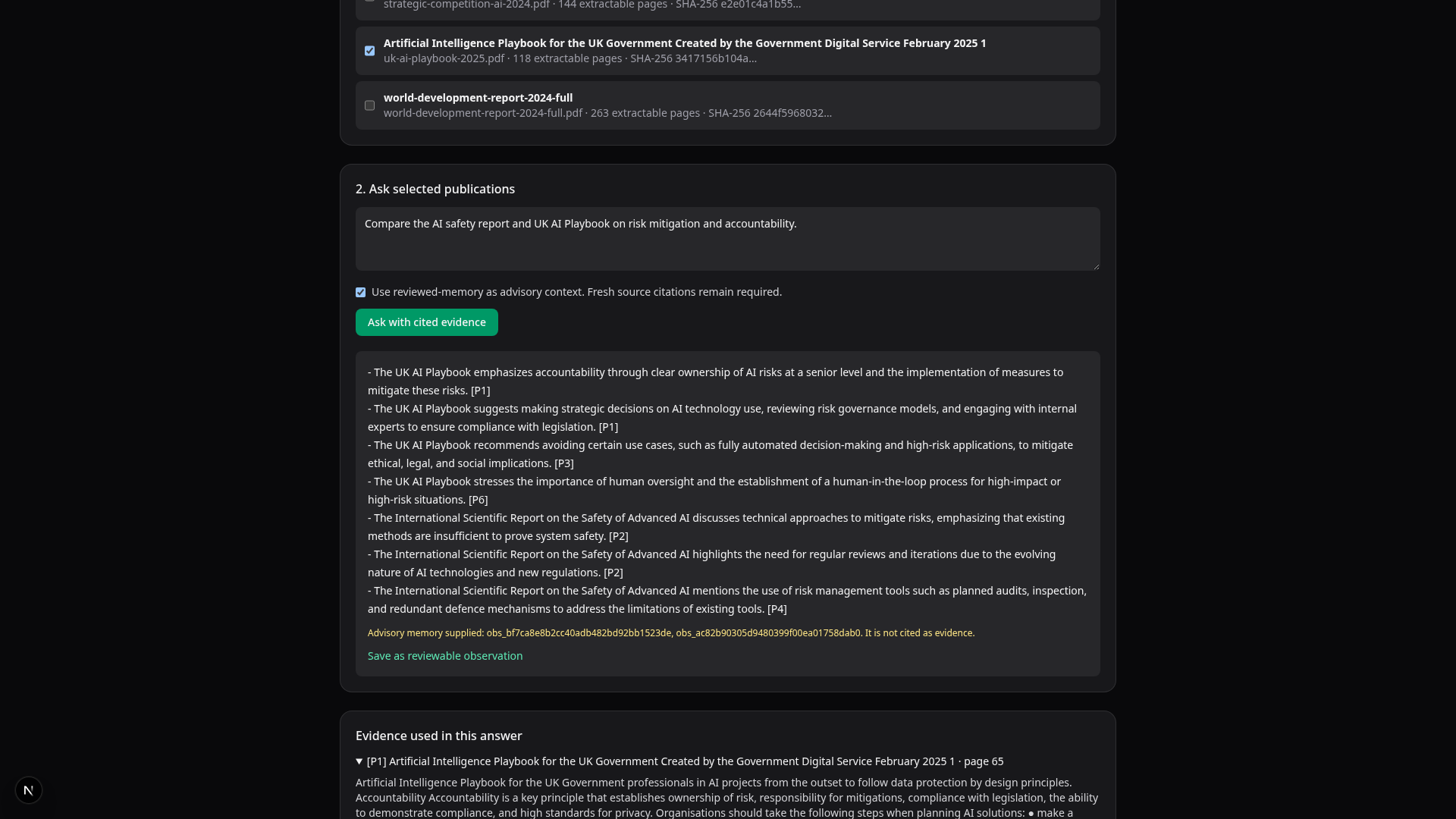
Document-heavy work becomes difficult when answers need to be traceable, current within a defined collection, and honest about uncertainty. This demonstration explores a source-first workflow for research teams and operations groups.
This is a local, single-user research-engine demonstration. It is not a deployed commercial SaaS product.
Permitted PDFs are indexed with page-aware text extraction, local embeddings, and a searchable collection.
Answers include source title, page, section, and publisher link. Citation markers are checked against retrieved evidence.
Candidate observations can be reviewed and revised. Memory remains advisory; fresh citations are still required.
Architecture
Next.js and TypeScript provide the workspace interface. FastAPI and SQLite support the local API and persistence. PyMuPDF, MiniLM embeddings, FAISS, and an Ollama-compatible Qwen-class model support the research loop.
When available evidence is insufficient, the system abstains rather than presenting an unsupported answer.
Demonstration
Evidence
Source: public research-engine repository, including README architecture, safeguards, verification reports, screenshots, event timelines, and demonstration videos.
What this means for a business
The pattern is relevant to policy lookup, internal research, and document-heavy decisions where a helpful answer must remain reviewable.
Discuss a workflow ↗